How on-chain agents make multi-billion DeFi failures structurally impossible
Smart contracts execute against whatever data they're handed and have no way to ask whether it's real. That limitation has cost DeFi billions. On-chain agents change it.
For a decade, DeFi has lost billions to the same mistake: smart contracts aren't smart. They're deterministic programs that follow set rules based on the data they receive. They can't analyze the inputs they act on to decide whether those inputs make sense.
This structural flaw has cost DeFi billions, and every post-mortem skirts around it. They point fingers at the oracle, the price feed, the TWAP window, or the decentralized network's economic security. But the failures all share one underlying cause: a contract obeyed a value that didn't reflect market reality, because it had no way to perceive that reality.
Not every DeFi loss is a perception failure. Wormhole, Ronin, and Poly Network were code bugs; many losses are key compromises. Adding perception doesn't fix those. But the single biggest recurring category of losses, the one the industry keeps blaming on oracles, is exactly what perception removes.
The industry's response has been to build better oracles: bigger node networks, more aggregation, longer TWAPs, decentralized data committees with staking, slashing, and dispute windows. It hasn't worked, because oracles aren't a feature of DeFi, they're a workaround. The category exists because smart contracts cannot see, so crypto glued a feed onto them and hoped the feed would be enough. It was never going to be enough.
Each generation of oracle improvements on the top track was followed by another generation of oracle-manipulation exploits on the bottom track. Approximate dollar amounts from public post-mortems; categorization reflects whether the exploit hinged on price or data perception.
Smart contracts + inference
Once a contract can run inference, it acts on what is happening instead of on a number it was handed. A lending protocol stops asking "what is the price of this collateral?" and starts checking whether the collateral can actually be sold at that price right now. A stablecoin catches its own depeg and pauses minting before the cascade. A perpetuals platform lowers leverage caps when funding diverges from the index. An insurance market reprices risk as conditions change instead of waiting on a quarterly governance vote.
Smart contracts can't do any of this. Agents can. These are reactive protocols: they read the market and adjust to it.
On-chain agents are protocols
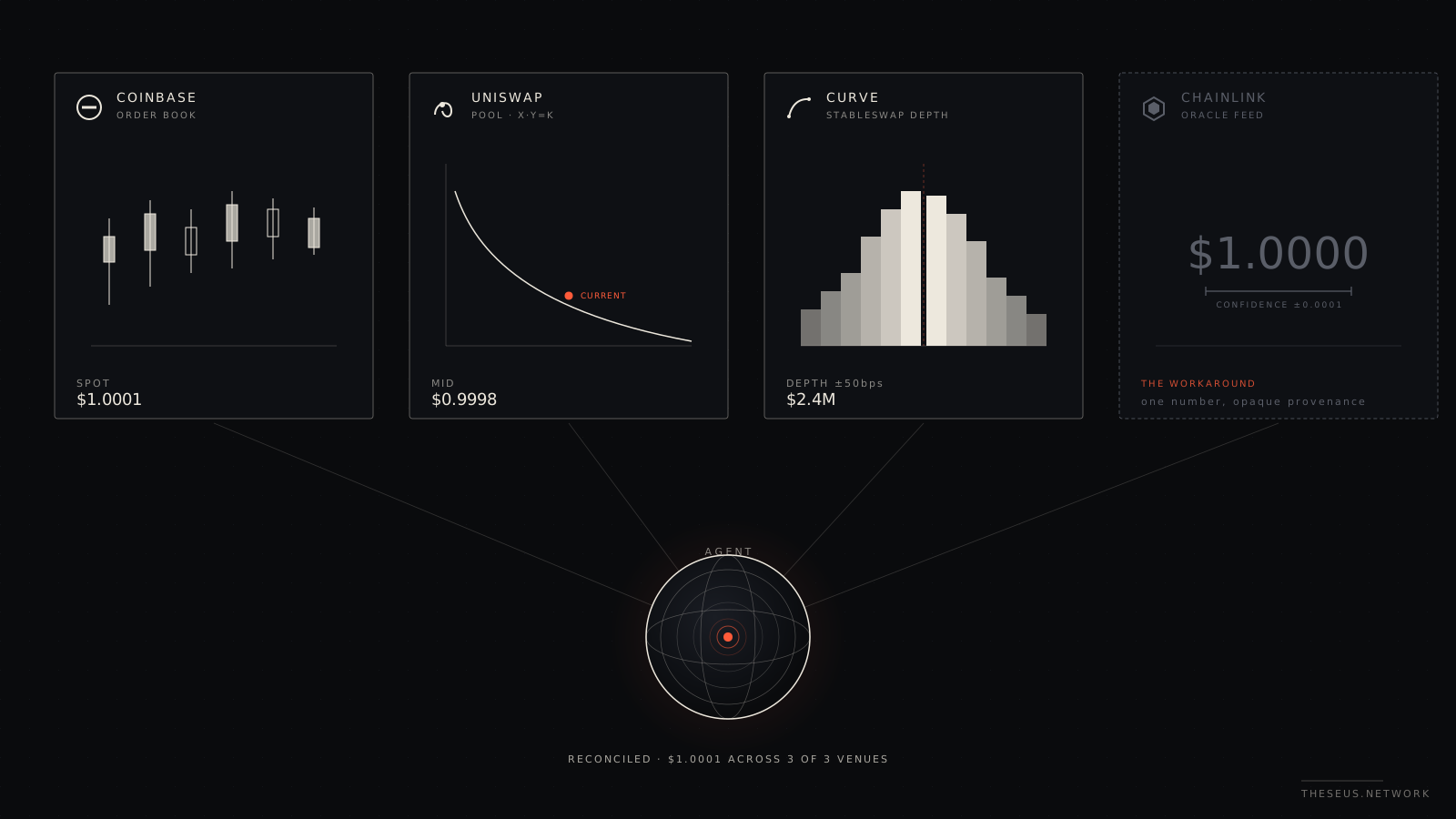
Three architectures for on-chain price decisions. The contract-and-oracle pattern obeys whatever the oracle reports. The agent-as-protocol pattern reads multiple venues directly and refuses when they don't reconcile. Verifiable inference handles the single-point-of-failure objection: one node runs the agent, many nodes verify the proof.
With on-chain agents, the contract-and-oracle architecture collapses. The agent is the protocol. The decision logic itself becomes an entity that can see and reason. We argued in Agents as an Evolution of Smart Contracts that this is the natural endpoint of the smart-contract trajectory; this is what it looks like in DeFi.
A lending agent on Theseus doesn't subscribe to a price feed. It reads Coinbase's order book directly, pulls Binance trade flow, checks whether the current price is consistent with realized volume. It queries Uniswap pool reserves and TWAPs, weights them by depth, compares against centralized venues, reconciles. Price becomes something the agent infers from the world, not something handed to it. Redemption queues, pool imbalances, venue divergences are all observable, all part of the input. The agent refuses to act when observations don't reconcile. It looks at the market.
Running the decision on a single agent sounds worse than a quorum of oracle nodes voting on a price. Verifiable inference handles that. One node runs the agent, other nodes verify a proof of what it computed, and the chain rejects results whose proofs don't check out.
Agents have their own bugs. A buggy policy, a poisoned context window, a hallucinated tool call. How AI Agents Actually Own Assets covers how Theseus contains them: bounded action layers, provable provenance, and pre-execution checks against what the agent said it would do.
The dumb contract had one option: obey. The agent has policy, perception, and verifiability. The next generation of on-chain protocols won't have better oracles. They'll have agents.
Agents save DeFi
What the oracle reported vs what the market actually was, in three of DeFi's largest perception failures. Dollar amounts are approximate; the Terra figure reflects market cap loss, Mango and Cream reflect attacker extraction.
The biggest perception failures in DeFi all share one feature: contracts that obediently executed against bad data.
Terra (LUNA) kept minting into a market that had already rejected the peg. An agent observing redemption queues, pool imbalances, and venue divergences would have detected the broken peg in real time and halted issuance.
Mango Markets accepted an oracle price manipulated by a single attacker inflating the MNGO mark on its own perpetual. An agent reading depth across multiple venues and reconciling against exitability would have refused the price.
Cream Finance ($130M, October 2021) accepted a flash-loan-manipulated price for yUSD and lent against it; the contract enforced its rules perfectly against a price that didn't survive contact with the rest of the market. An agent comparing the manipulated price against the underlying assets' actual depth would have refused.
In each case, the contract did exactly what it was programmed to do, and that was the problem. An agent reading the market directly would have stopped.
Theseus is building the agent runtime that makes this possible: stateful, sovereign, verifiable agents that exist as first-class on-chain entities with the cognitive capability of modern AI agents and the trust properties of a smart contract. Learn more.