
System Architecture
Three-layer architecture built for AI workloads: execution, storage, and consensus working as one system.
In one paragraph
- Chain: Substrate runtime with Theseus-specific pallets (aivm, models, agents, tools, store, ship) plus standard FRAME pallets for balances and BFT consensus.
- Prover network: full prover with TensorCommitment proofs, plus lite provers for hosted-API breadth at alpha.
- Blessed enclave: TEE that holds the chain’s key, executes off-chain tools (web search, authenticated HTTP), decrypts agent credentials.
- Layer0 bridge: any token bridges in; seus (gas) is bought only with frxUSD.
Architectural Overview
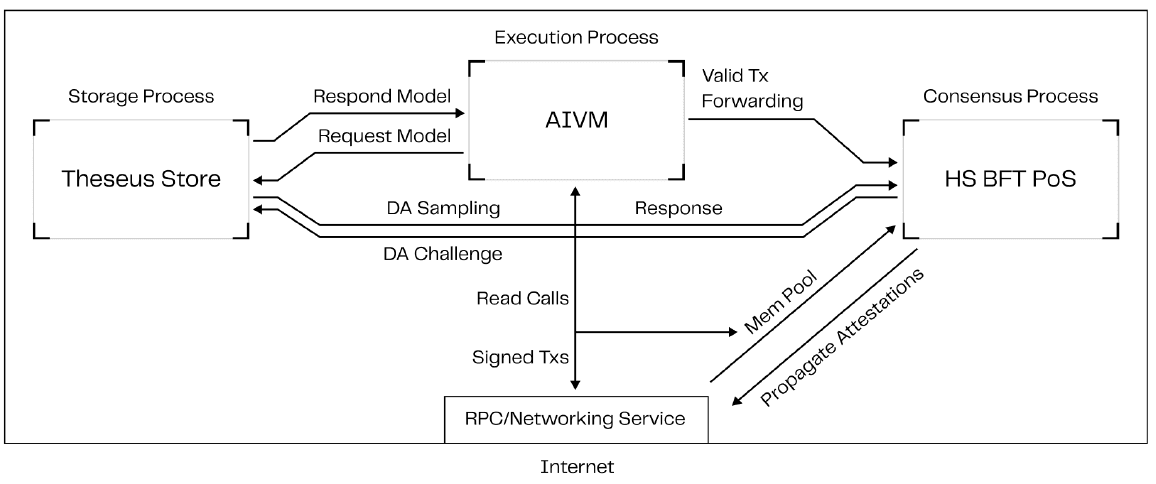
Three main processes
Three-Layer Stack
Execution Layer: AIVM
Deterministic tensor-native runtime with Tensor Commits:
Availability Layer: TheseusStore
Off-chain DA layer for model weights and agent contexts. Integrity comes from on-chain anchors, not the storage layer:
Consensus Layer: BFT proof-of-stake
Deterministic finality once 2/3 of validators agree. AI-specific gating folded in:
Block Structure
header {
  parent_hash, height, timestamp
  post-state Merkle root
  Terkle tree of Tensor Commits
  Merkle root of available model and context blobs
  gas limit
  VRF-selected validator signature
}
body { Transaction[] }
A block cannot finalize unless both conditions hold:
TheseusStore Deep Dive
TheseusStore is the availability layer, handling gigabytes of model weights and agent context on-chain.
Model storage
Immutable weights addressed by their on-chain weights_root. Provers fetch by root and verify integrity (Merkle / Verkle proofs) before running inference.
Context storage
Agent execution context and the AKG live behind a per-agent context_root. Updated by pallet_agents as agents execute; readers verify retrievals against the anchor.
Correctness vs availability
Consensus nodes never trust raw bytes from TheseusStore. They fetch by content-addressed root and verify against the on-chain anchor. As long as one honest full node can obtain the data and verify it against the root, the state transition stays correct.
The DA layer’s economics ensure availability, not integrity. Integrity is cryptographic. See Data Availability for the full breakdown.
Prover and Verifier Selection
Provers
Run full forward passes. VRF selects by capacity + stake.
Verifiers
All active verifiers check every inference.
Security Model
Theseus assumes a partially synchronous network with up to 1/3 byzantine validator stake. Within those bounds, three properties are protected by economic and cryptographic mechanisms working together.
Inference integrity
A dishonest prover producing a wrong inference result is caught by Tensor Commit verification: every active verifier rechecks every proof in roughly 12 ms. A faulty proof fails KZG pairing checks deterministically.
Slash condition: invalid Tensor Commit. Stake is burned, and the inference is rejected before the block can finalize.
Liveness
A request must reach an honest prover that can run the model. The protocol picks n candidates per request via VRF, weighted by stake and hardware capacity. The probability that at least one is honest is:
Where h is the honest fraction. With h = 0.67 and n = 10, liveness is >99.99% per request. With h = 0.33 worst-case and n = 10, >98%.
Data availability
Model weights and agent context must be retrievable for provers to run, for verifiers to check proofs, and for agents to make progress. The on-chain anchor (weights_root / context_root) guarantees integrity; the DA layer’s economics guarantee availability.
Substrate Off-chain Workers periodically sample data referenced by anchored roots, with unsigned transactions recording evidence of unavailability and triggering slashing. See Data Availability.
Out of scope
Transaction Lifecycle
Model Deployment
Developer uploads weights (with Tensor Commit) to TheseusStore
Inference Transaction
User submits {modelRoot, input, maxGas} to AIVM
Block Proposal
Validator packages model and inference TXs with TheseusStore root
Execution & Proofing
AIVM runs the model and emits a Tensor Commit receipt
Finality
PoS finalizes; TheseusStore miners pin any new context/model shards