
Tensor Commits Protocol
The security base of Theseus: public verifiability and tamper-proof computations with <1% overhead.
Overview
Tensor-commit protocols enable verifiable ML by proving a model was executed correctly. Traditional verification via recomputation is prohibitively expensive for large models.
Theseus' Tensor Commits provide batch verification and reduce opening costs through a novel application of KZG commitment schemes extended to multi-dimensional tensor structures.
How Tensor Commits Work
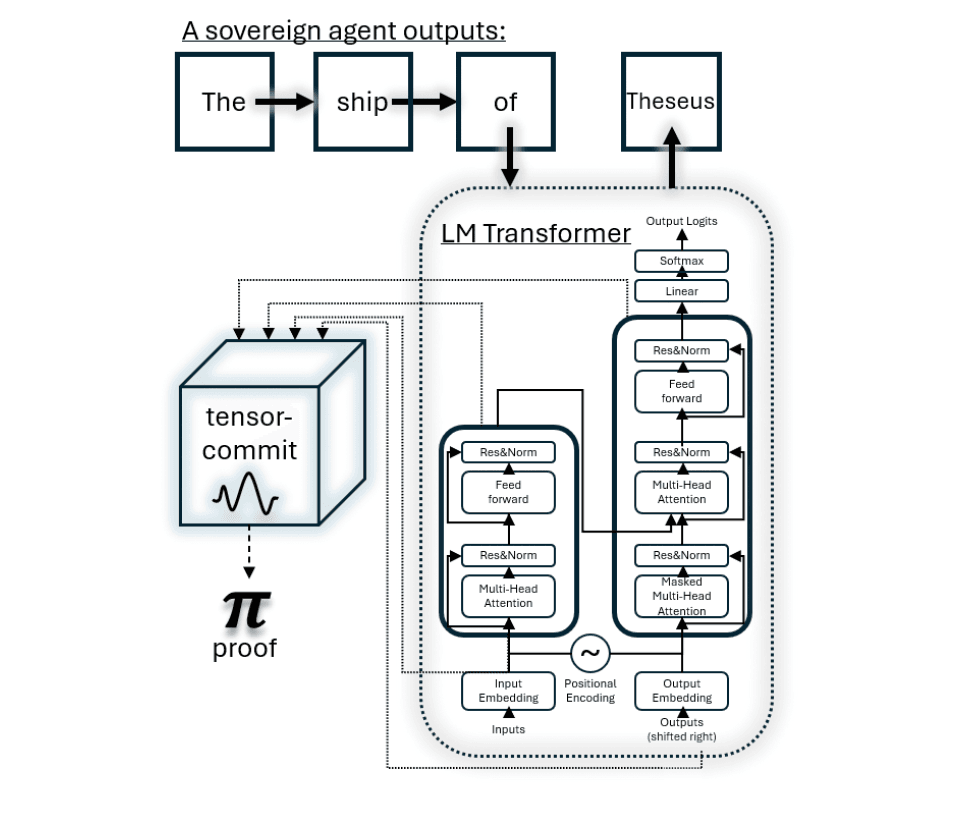
Figure Explanation
Key Achievements
<1% Proof Generation
Minimal impact on inference performance. Practical for production workloads.
<0.1% Verification Time
Verifiers check proofs in milliseconds. Thousands can audit simultaneously.
Efficient & Scalable
Terkle Trees
A Terkle tree (tensor Merkle tree) has leaves that are sub-tensors and internal nodes that carry tensor commitments instead of hash values.
Structure
- • Each dimension j has mⱼ blocks
- • Each leaf cℓ is a commitment of sub-tensor Tℓ
- • Parents commit to children tensor concatenation
- • Root cᵣₒₒₜ is the global model fingerprint
Benefits
- • Batch verification: Multiple ops in one proof
- • Selective opening: Without revealing full model
- • Efficient proofs: Logarithmic proof size
- • Hierarchical: Natural fit for NN layers
Verification Process
Model Registration
Prover uploads weights with Tensor Commit. Commitment stored on-chain as canonical fingerprint.
Inference Execution
Prover runs forward pass, emits proof with opening, input embeddings, layer outputs, and Merkle path.
Verification
Every verifier checks every inference. ~12ms check time, gossip once, 2/3 BFT agreement needed.
Performance Comparison
Per-op cost on Theseus, with proof generation and verification overhead included.
| Operation | Latency | Proof Size | Gas Cost |
|---|---|---|---|
| TMATMUL 512x512 | 4.1 ms | 230 KB | 18K |
| TSTREAM 4x512 | 8.6 ms | 400 KB | 27K |
| TCOMMIT 70B | 22 ms | 470 KB | 120K |
* Gas costs based on base-load multiplier m = 1.0
Versus alternatives
How Tensor Commits compare to the two main approaches for verifying neural network inference: re-executing the model on every node, and zkML proofs.
| Approach | Full re-execution | zkML (zk-SNARK) | Tensor Commits |
|---|---|---|---|
| Verifier work per inference | Same as the prover | Milliseconds (constant) | ~12 ms |
| Prover overhead vs raw inference | 0% (no separate proof) | 1000-100,000x | <1% |
| Practical model size | Limited by smallest validator | Small models (mostly) | Frontier (70B+) |
| Proof size | Not applicable | ~KB | ~KB to MB |
| Hides model weights from verifier | No (verifier needs weights) | Yes | Yes |
| Tampering caught | Exact (full recompute) | Cryptographically sound | ~96% (linear sound, nonlinear sampled) |
Re-execution is the design Ethereum uses for smart contracts and the reason on-chain inference at frontier sizes is impractical there. zkML produces succinct proofs but the prover-side overhead is what has kept it limited to small networks. Tensor Commits target the same proof-size benefit as zkML with overhead that does not break the economics for production-sized models. On the paper’s LLaMA2-13B benchmark that is about 0.96% added to the prover and a ~12 ms check on a CPU, against seconds of verify time and tens of gigabytes of GPU for the zk-SNARK baseline.
LLM-Specific Optimizations
Token Embeddings
Committed polynomially with positional encoding using homomorphic properties
Layer Normalization
Mean/variance via polynomial commitments, inverse sqrt via polynomial approximation
Multi-Head Attention
Q, K, V matrices committed individually, attention scores polynomially approximated
Residual Connections
Handled via commitment homomorphism, layers reuse prior commitments
Mixture-of-Experts
Sparse expert activations committed efficiently, only activated experts contribute